

Dear friends!
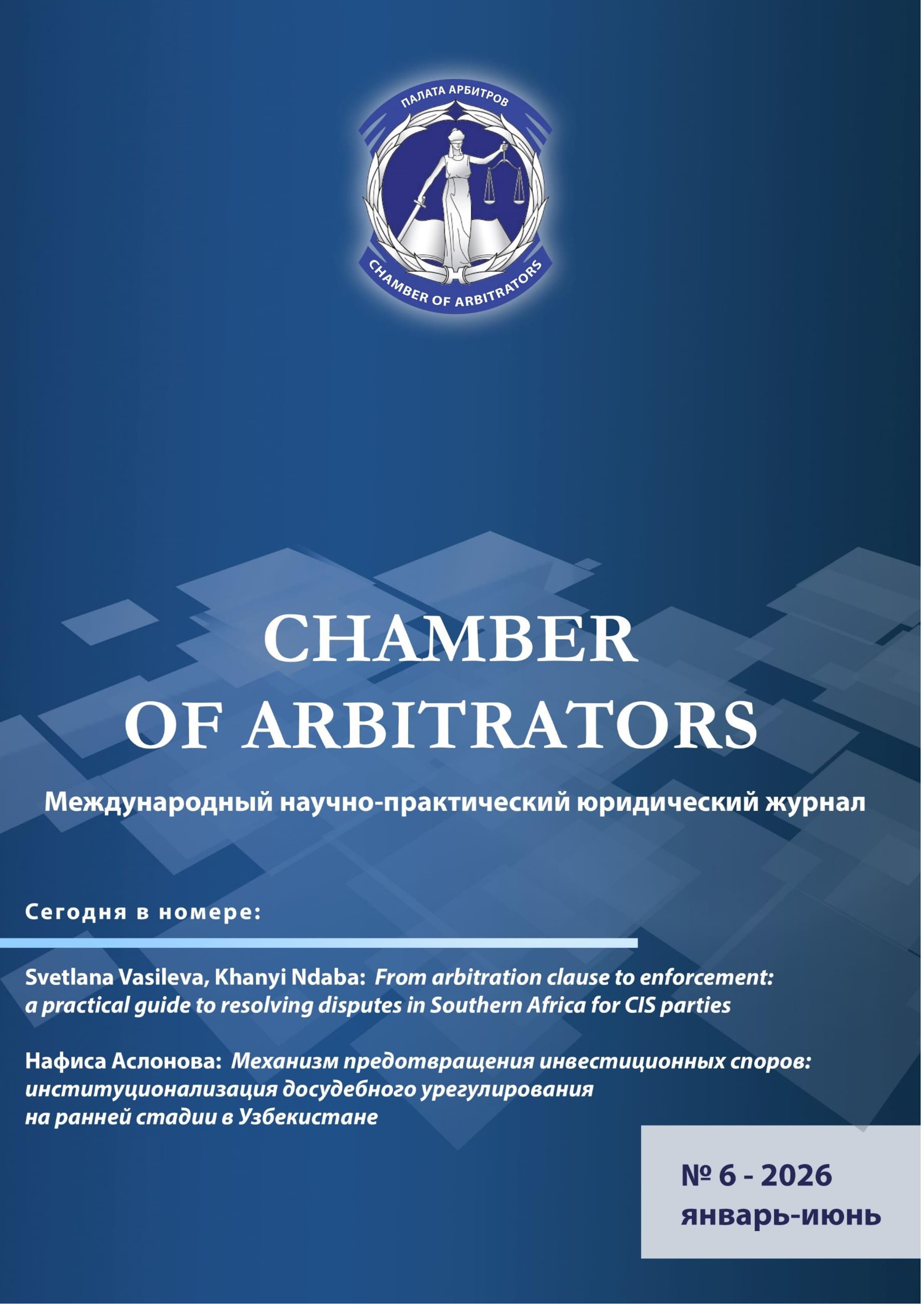
Here is the sixth issue of our specialized publication “Chamber of Arbitrators.” We have traditionally sought to bring together materials that combine theory and practice, national experience and international perspective. The new issue has turned out to be particularly broad in geography and subject matter: from Central Asia and Kazakhstan to South Africa, from investment disputes to digitalization and artificial intelligence.
The issue opens with an article by N. Aslonova on the mechanism for preventing investment disputes in Uzbekistan. The author analyzes the institutionalization of pre-trial settlement at an early stage, the role of the Tashkent International Arbitration Centre (TIAC), ICSID statistics, and procedural guarantees of an independent preliminary assessment. Of particular interest is the description of TIAC’s interaction with the Ministry of Investment, Industry and Trade of the Republic of Uzbekistan.
The article by M.K. Suleimenov and A.E. Duisenova addresses fundamental issues of space and time in arbitration proceedings. The authors examine the scope of the Law of the Republic of Kazakhstan “On Arbitration,” the seat of arbitration, substantive and procedural time limits, the autonomy of the arbitration agreement, and the practice of the Kazakhstan International Arbitration. This material will be useful to all who work in the post-Soviet arbitration space.
An article by S. Vasileva and K. Ndaba serves as a practical guide for parties from the CIS conducting cases in South Africa. The authors guide the reader from the arbitration clause to recognition and enforcement of the award, dwelling in detail on the choice of seat of arbitration, interim measures, judicial support, state immunity, currency control, and sanctions issues. The AFSA checklist deserves special attention.
The issue concludes with an article by A. Ubaidullaeva on the evolution of international commercial arbitration in Uzbekistan. It analyzes the 2021 reforms, the role of TIAC, recognition and enforcement of arbitral awards, and the challenges of the digital economy and artificial intelligence.
We are confident that the materials in the sixth issue will be useful both to practicing arbitrators, mediators, and lawyers and to researchers, teachers, and students. We thank the authors for their cooperation and invite readers to join the discussion.
The contents of the latest issue can be found at the link.


Our social media: